
Blog
What Is BPC-157? A Research-Backed Guide to Body Protection Compound

What Is BPC-157? A Research-Backed Guide to Body Protection Compound
Choice Peptide Labs | 14 min read | 544 published papers reviewed | June 2026
BPC-157 may have the largest preclinical evidence base of any peptide not currently approved as a medication. Over 544 published papers spanning three decades have investigated this 15-amino acid compound across gut protection, tissue repair, vascular biology, and neurological function. Here’s what the research actually shows.
What Exactly Is BPC-157?
BPC stands for Body Protection Compound. BPC-157 is a 15-amino acid peptide fragment originally isolated from a protein found in human gastric juice — the digestive fluid in your stomach.
It was first studied in the context of gastrointestinal protection — hence the name. But the research didn’t stop at the gut. Over the following three decades, BPC-157 was studied in tendon, ligament, nerve, muscle, bone, and vascular repair models — with consistently positive findings across every tissue type tested.
“More than 200 published studies have investigated BPC-157 for tissue repair, gut healing, and inflammation, and the results in animal models are consistently positive across every tissue type tested.” — Peptide Science Institute
The Nitric Oxide Connection: How BPC-157 Works
BPC-157 doesn’t act through a single, well-defined receptor. Published research suggests it operates through multiple overlapping mechanisms.
Nitric Oxide (NO) System Modulation
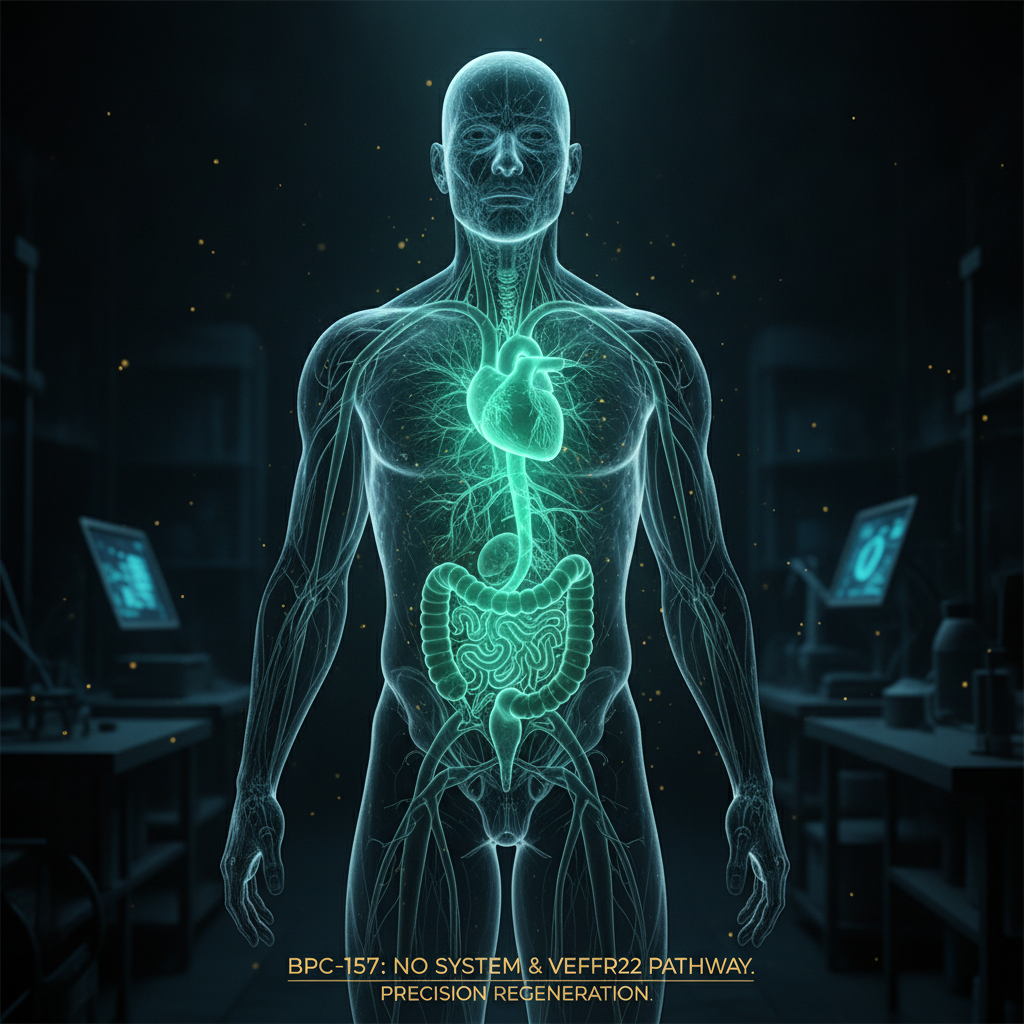
The most extensively studied mechanism involves the nitric oxide (NO) system. Research primarily from the Sikiric group at the University of Zagreb has demonstrated that BPC-157 interacts with the NO signaling pathway through two converging routes:
- VEGFR2-Akt-eNOS pathway: BPC-157 activates VEGFR2, which triggers PI3K/Akt phosphorylation of endothelial nitric oxide synthase (eNOS).
- Src-Caveolin-1-eNOS pathway: BPC-157 also operates through Src kinases and Caveolin-1, releasing eNOS from its inhibited state. Both pathways converge on enhanced NO production.
Source: Hsieh, M.J., et al. “Modulatory effects of BPC 157 on vasomotor tone.” Scientific Reports (Nature), 10, 17078. Nature
Source: Chang, C.H., et al. “BPC 157 Therapy: Targeting Angiogenesis and Nitric Oxide.” Pharmaceuticals, 18(10), 1450. MDPI
What the Published Research Shows
A 2025 systematic review published in the Journal of Orthopaedic Research analyzed 544 articles from 1993 to 2024. After removing duplicates, 36 studies met inclusion criteria — 35 preclinical and 1 clinical.
Gastrointestinal Cytoprotection
- BPC-157 was originally studied for protecting the gastric mucosa — the stomach and intestinal lining
- Multiple studies examined effects on ulcer formation, NSAID-induced damage, and intestinal permeability
- Researchers documented faster mucosal healing and reduced ulcer severity in preclinical models
Tendon and Ligament Repair
- Preclinical models showed faster healing and stronger tissue formation in transected tendons
- Improved collagen organization and mechanical strength at repair sites were documented
Vascular Repair and Angiogenesis
- Through the NO system, BPC-157 promotes new blood vessel formation at injury sites
- Improved vascular integrity was documented in ischemic tissue models
Nerve and Neurological Function
- Published studies examined BPC-157 in nerve crush injury and traumatic brain injury models
- Improved functional recovery and reduced neural inflammation were documented
Growth Hormone Receptor Expression
- The 2025 systematic review found BPC-157 enhances growth hormone receptor expression
- It activates multiple pathways involved in cell growth and angiogenesis
Source: “Emerging Use of BPC-157 in Orthopaedic Sports Medicine: A Systematic Review.” Journal of Orthopaedic Research (SAGE), 2025. SAGE Journals
Beyond the Gut: Why BPC-157 Is Studied in So Many Tissue Types
BPC-157 operates through fundamental cellular processes rather than tissue-specific pathways:
- NO system modulation affects virtually every tissue in the body
- Growth hormone receptor enhancement is a systemic effect
- Angiogenesis promotion benefits any tissue needing improved blood supply during repair
- Anti-inflammatory signaling reduces damage across multiple tissue types simultaneously
Important Context: Preclinical vs. Clinical Evidence
This is where intellectual honesty matters. Of the 544 published papers on BPC-157:
- The vast majority are preclinical — conducted in animal models (primarily rats) and cell culture systems
- Only approximately 30 human subjects have ever been studied
- 35 of the 36 studies in the 2025 systematic review were preclinical
- BPC-157 is not FDA-approved for any medical use
“BPC-157 has 544 published papers and massive internet hype. But only ~30 humans have ever been studied.” — Rethink Peptides
BPC-157 and the NO System: A Deeper Look
Nitric oxide (NO) is a gas molecule that regulates vasodilation, angiogenesis, inflammation resolution, and platelet function. BPC-157 enhances eNOS activity through two converging pathways — essentially upregulating the body’s own vascular repair system.
The convergent model is key: if one pathway is impaired, the other can still produce the effect. This redundancy may explain BPC-157’s consistent results across diverse experimental conditions.
Frequently Asked Questions About BPC-157
What does BPC-157 stand for?
BPC stands for “Body Protection Compound.” Named for its observed protective effects on the gastrointestinal system. The “157” is a designation number.
How many studies have been done on BPC-157?
Over 544 published papers from 1993 to 2024. A 2025 systematic review analyzed 36 studies that met inclusion criteria.
How does BPC-157 work?
Primarily through nitric oxide (NO) system modulation via VEGFR2-Akt-eNOS and Src-Caveolin-1-eNOS pathways, plus GH receptor expression enhancement.
Has BPC-157 been tested in humans?
Only 1 clinical study out of 36 analyzed. Approximately 30 human subjects total. BPC-157 is not FDA-approved.
How does BPC-157 compare to TB-500?
BPC-157 works through NO system modulation. TB-500 works through actin sequestration. They are complementary mechanisms sometimes studied in combination.
Why was BPC-157 discovered in stomach fluid?
It was isolated from a protein in gastric juice during research on gastrointestinal protection. Effects beyond the gut were discovered later.
What is the nitric oxide (NO) system?
NO is a gas molecule produced by eNOS in blood vessel walls. It regulates vasodilation, angiogenesis, inflammation, and platelet function. BPC-157 enhances eNOS through two converging pathways.
What is a Certificate of Analysis for BPC-157?
An independent lab report showing HPLC purity testing and mass spectrometry for a specific batch. Choice Peptide Labs publishes one for every batch.
How does BPC-157 compare to other peptides?
By volume, BPC-157 has one of the largest preclinical evidence bases — 544 papers. TB-500 has ~148. The breadth across tissue types is unusual among peptides.
Explore BPC-157 from Choice Peptide Labs
10mg vial · Published Certificate of Analysis for every batch · USA-stocked · Cold-chain shipped
Disclaimer: This article is for educational and informational purposes only. BPC-157 is a research compound not approved by the FDA for human use. All products from Choice Peptide Labs are for laboratory research use only and are not intended for human or veterinary consumption.

