
Blog
What Is the KLOW Blend? A Research-Backed Guide to 4-Peptide Recovery

What Is the KLOW Stack? A Research-Backed Guide to 4-Peptide Soft Tissue Protocols
Choice Peptide Labs | 15 min read | 4 independent peptide mechanisms | June 2026
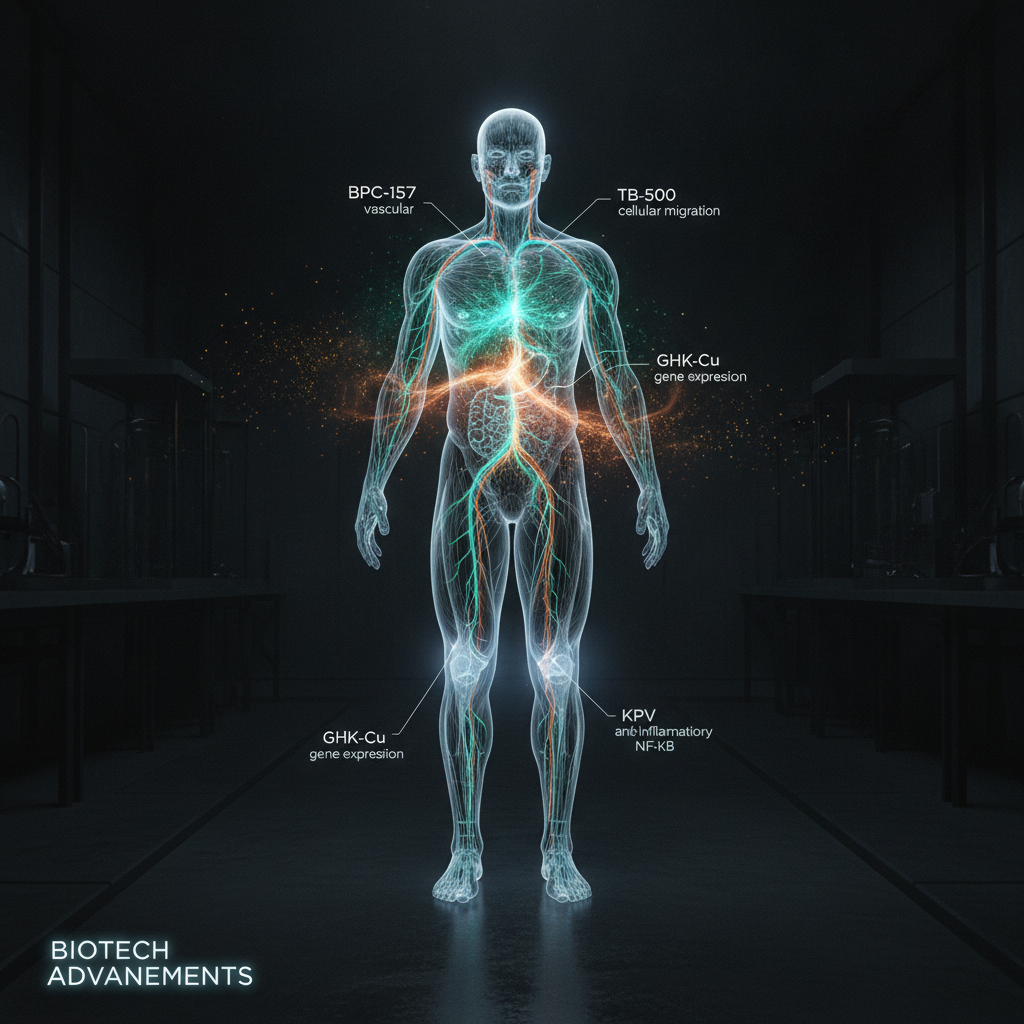
KLOW combines four peptides — KPV, BPC-157, TB-500, and GHK-Cu — into a single pre-blended vial. Each peptide has its own published research history and acts through a completely different biological mechanism. Here’s what each one brings to the literature, and why researchers study them together.
What Is KLOW?
KLOW is a research-context name for a four-peptide blend that pairs compounds with distinct and non-overlapping mechanisms of action. The four peptides:
| Peptide | Primary Mechanism | Research Focus |
|---|---|---|
| KPV | NF-κB pathway inhibition | Mucosal inflammation, immune signaling |
| BPC-157 | NO system modulation + GH receptor expression | Gut, tendon, vascular, nerve repair |
| TB-500 | Actin sequestration + angiogenesis | Cell migration, wound healing, cardiac |
| GHK-Cu | Gene expression modulation (4,000+ genes) | Collagen synthesis, antioxidant defense, skin |
Each peptide was chosen because its mechanism is independent of the others. There is no receptor overlap, no shared signaling pathway, and no redundancy.
Peptide #1: KPV — The Inflammation Signal Blocker
KPV is a tripeptide (lysine-proline-valine) and a C-terminal fragment of alpha-melanocyte-stimulating hormone (alpha-MSH). It specifically retains anti-inflammatory properties through NF-κB pathway modulation.
What is NF-κB? Nuclear factor kappa B is a protein complex that acts as a master switch for inflammation. When activated, it triggers the production of inflammatory cytokines — the signaling molecules that drive swelling, pain, and tissue damage.
Published research on KPV has examined:
- Inhibition of NF-κB activation in intestinal tissue models
- Reduction of pro-inflammatory cytokine production in mucosal inflammation
- Effects on gut barrier function and intestinal permeability
- Anti-inflammatory activity in inflammatory bowel disease (IBD) models
Source: Getting, S.J., et al. “alpha-MSH peptides inhibit inflammation through NF-κB.” Journal of Immunology. PubMed
Peptide #2: BPC-157 — The Vascular Repair Activator
With 544 published papers, BPC-157 has the largest preclinical evidence base of the four. Originally isolated from gastric juice, it works through the nitric oxide (NO) system via two converging pathways: VEGFR2-Akt-eNOS and Src-Caveolin-1-eNOS.
- New blood vessel formation (angiogenesis) at injury sites
- Improved vascular integrity and blood flow
- Tendon and ligament repair in preclinical models
- Gastrointestinal mucosal protection
Source: Hsieh, M.J., et al. Scientific Reports (Nature), 10, 17078. Nature
Peptide #3: TB-500 — The Cell Migration Engine
A 43-amino acid synthetic fragment of Thymosin Beta-4. Over 148 published studies. TB-500 regulates G-actin — the protein that drives cell movement, division, and tissue remodeling.
- Actin regulation enables cell migration to wound sites
- The LKKTETQ domain promotes new blood vessel formation
- Faster wound closure and reduced scarring in preclinical models
Source: Huff, T., et al. FASEB Journal, 18(11), 1254–1256. DOI
Peptide #4: GHK-Cu — The Gene Expression Modulator
A copper-binding tripeptide identified by Loren Pickart in 1973. Gene expression research using the Broad Institute’s Connectivity Map showed GHK-Cu modulates ~32% of the human genome (4,000+ genes).
- Upregulates: Collagen, glycosaminoglycans, decorin — structural components of skin and connective tissue
- Downregulates: NF-κB inflammatory gene expression (complementing KPV)
- Activates: Nrf2 antioxidant defense pathways
- Promotes: Wound remodeling and fibroblast activity
Source: Pickart, L., et al. PMC6073405. PMC
Why Combine Four Peptides Instead of One?
Soft tissue repair involves multiple simultaneous biological processes:
- Inflammation control — the environment must be managed before repair proceeds (KPV)
- Blood supply restoration — damaged tissue needs oxygen and nutrients (BPC-157)
- Cell migration and remodeling — cells need to physically move to the injury site (TB-500)
- Extracellular matrix synthesis — structural scaffolding needs to be produced (GHK-Cu)
A single peptide addresses one or two of these. KLOW addresses all four through independent, non-overlapping mechanisms.
KLOW as a Research Tool
KLOW comes as a single pre-blended lyophilized vial containing all four compounds. This format eliminates the need to source, reconstitute, and prepare each peptide individually. Every batch ships with a published Certificate of Analysis showing purity verification for each compound.
Frequently Asked Questions
What does KLOW stand for?
KLOW is a research-context name for KPV + BPC-157 + TB-500 + GHK-Cu. The name references the blend’s focus on soft tissue repair through complementary mechanisms.
Why are these four peptides combined?
Each acts through a different mechanism: KPV blocks NF-κB, BPC-157 modulates NO, TB-500 regulates actin, GHK-Cu modulates gene expression. No receptor overlap.
Is KLOW a single compound or four?
Four separate peptides in a single pre-blended lyophilized vial for research convenience.
What is KPV?
A tripeptide fragment of alpha-MSH that inhibits the NF-κB inflammation pathway. Studied in mucosal and intestinal inflammation models.
How does GHK-Cu modulate gene expression?
Research using the Broad Institute’s Connectivity Map showed it modulates 4,000+ genes (~32% of the genome) — upregulating structural proteins and downregulating inflammatory pathways.
Has KLOW been studied as a combination?
The individual peptides have extensive research bases (BPC-157: 544 papers, TB-500: 148+ studies, GHK-Cu: 50+ years). The combination rationale is based on mechanistic complementarity.
How does KLOW compare to using individual peptides?
It addresses four biological processes simultaneously rather than one. Designed for research contexts examining multi-pathway approaches.
What is a COA for KLOW?
Purity verification for each of the four compounds using HPLC and mass spectrometry. Choice Peptide Labs publishes batch-specific COAs.
Explore KLOW from Choice Peptide Labs
80mg blend (KPV + BPC-157 + TB-500 + GHK-Cu) · Published COA · USA-stocked · Cold-chain shipped
Disclaimer: This article is for educational purposes only. All information is derived from published research on the individual peptides. All products from Choice Peptide Labs are for laboratory research use only.

